

Part 7 of my series on Craig Freedman’s SQL Server query-processing blog (part 6, November 2006, is here). December 2006 brought a single article before a longer writing break — but it’s a gem about optimizer internals, and it answers a very practical indexing question along the way.
All plan screenshots in this post are my own, made in SSMS with “Include Actual Execution Plan” (Ctrl+M). Want to follow along? Run this one-time setup in a scratch database (it uses GENERATE_SERIES, so SQL Server 2022 or later) — the cleanup is at the bottom of the post:
-- One-time setup for the examples in this post
CREATE TABLE dbo.T1 (a INT, b INT);   -- the big preserved side: 10,000 rows
CREATE TABLE dbo.T2 (a INT, b INT);   -- the small lookup side:     100 rows
INSERT dbo.T1 SELECT value, value FROM GENERATE_SERIES(0, 9999);
INSERT dbo.T2 SELECT value, value FROM GENERATE_SERIES(0, 99);28. Semi-join Transformation (December 4, 2006)
Setting: an EXISTS query where a big table (10,000 rows) is filtered against a small one (100 rows). The natural plan is a hash right semi-join — build on the small table, probe with the big one. Now the practical question: you want an index nested loops plan, so where does the index go? Intuition says on the small inner table. Craig shows that’s a dead end: 10,000 lookups against the small table still lose to the hash join. The winning move is the counter-intuitive one — index the big table.
The starting point, without any indexes — a hash right semi-join, build on the 100-row T2, probe with the 10,000-row T1:
SELECT * FROM dbo.T1
WHERE EXISTS (SELECT * FROM dbo.T2 WHERE T2.a = T1.a);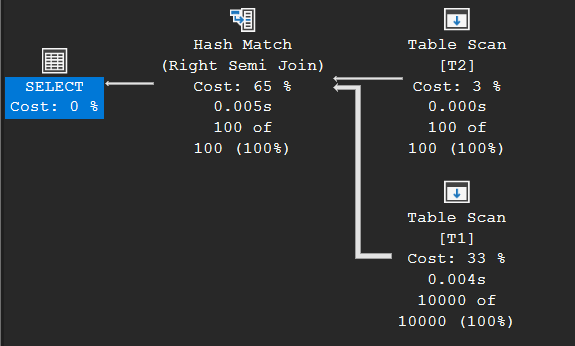
With that index in place, something surprising appears in the plan: the semi-join is gone, replaced by an inner join. That’s the semi-join transformation: a semi-join only needs each preserved row returned once, so the optimizer can deduplicate the lookup side (here a stream aggregate over the small table’s 100 values) and then run a plain inner join against the big table’s index — 100 index seeks instead of touching 10,000 rows. And because it’s now an ordinary inner join, the whole toolbox of join orders and algorithms opens up.
Here it is: after indexing the big table, the same EXISTS query compiles to a Distinct Sort over T2’s 100 values feeding a Nested Loops Inner Join that seeks into T1’s new index — 100 seeks instead of 10,000 probed rows, and no semi-join in sight:
CREATE CLUSTERED INDEX T1a ON dbo.T1 (a);
SELECT * FROM dbo.T1
WHERE EXISTS (SELECT * FROM dbo.T2 WHERE T2.a = T1.a);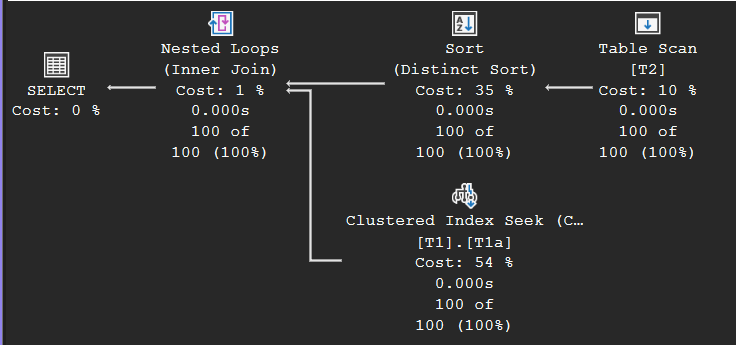
The transformation pays off in two situations: when it unlocks an index seek on the preserved side, as above; and when the lookup side is huge but full of duplicates — Craig’s second example collapses a 10,000-row all-duplicates table into a one-row hash table before the join. Best of all, with a unique index on the lookup side the deduplication step is free and the optimizer applies the transformation without any extra operators at all. A nice reminder that the optimizer reasons about your uniqueness guarantees — one more reason to declare them.
Both situations, reproduced. First the duplicate collapse: drop the index again, and aim the EXISTS at a 10,000-row table containing a single repeated value — a Hash Match (Aggregate) crushes it to one row before an inner hash join:
DROP INDEX T1a ON dbo.T1;
CREATE TABLE dbo.T3 (a INT, b INT);
INSERT dbo.T3 SELECT 0, value FROM GENERATE_SERIES(0, 9999);

SELECT * FROM dbo.T1
WHERE EXISTS (SELECT * FROM dbo.T3 WHERE T3.a = T1.a);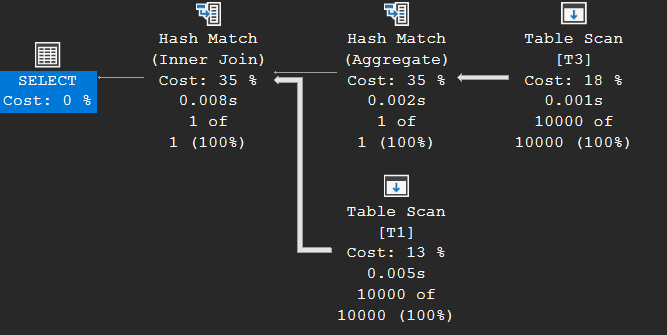
And the free variant: declare uniqueness on the lookup side and the dedup step vanishes — a plain Hash Match (Inner Join), no semi-join, no aggregate:
CREATE UNIQUE CLUSTERED INDEX T2a ON dbo.T2 (a);

SELECT * FROM dbo.T1
WHERE EXISTS (SELECT * FROM dbo.T2 WHERE T2.a = T1.a);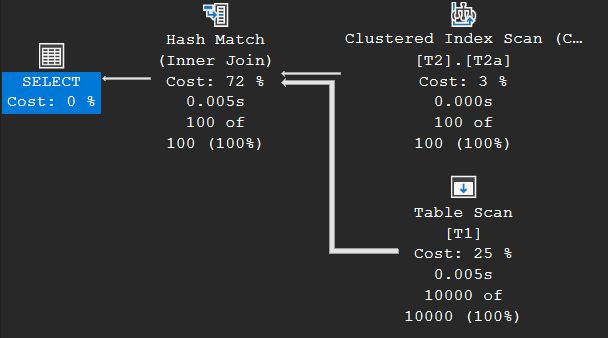
This closes out 2006 — six months, 28 articles, and a complete foundation: iterators, plans, access paths, joins, aggregation, subqueries, parallelism and partitioned tables. In the next part I move into 2007, where Craig switches gears to isolation levels and concurrency before returning to operators.
Done experimenting? This removes everything the setup created:
-- Cleanup
DROP TABLE IF EXISTS dbo.T1, dbo.T2, dbo.T3;